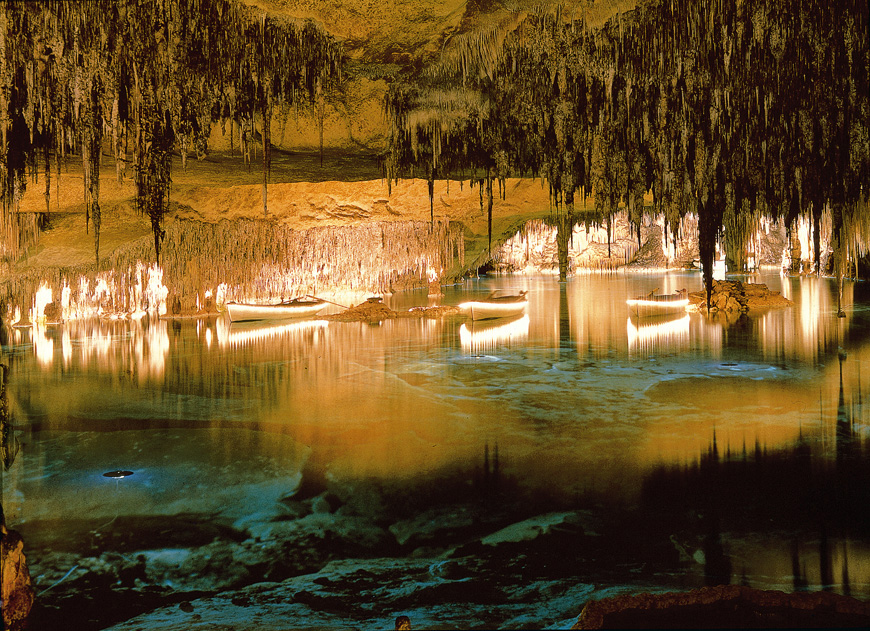
An Andalusian Underground Marvel
Along the sun-drenched coast of the Costa del Sol, just a few kilometers east of the picturesque town of Nerja, lies one of Spain's most visited natural attractions. The Caves of Nerja, or Cuevas de Nerja, stretch across nearly 5 kilometers of underground galleries filled with extraordinary geological formations that have been developing for millions of years.
Sitting at an elevation of 158 meters above sea level in the foothills of the Sierra Almijara, these caves offer a remarkable contrast to the Mediterranean sunshine above. Inside, a constant temperature of around 19 degrees Celsius and high humidity levels have created the perfect conditions for the growth of massive stalactites, stalagmites, and columns that transform the underground chambers into natural cathedrals.

A Modern Rediscovery
Although the caves had been known to local shepherds for centuries, their modern rediscovery came on January 12, 1959, when five local teenagers from the nearby village of Maro stumbled upon an entrance while exploring the hillside. Searching for bats in the Sierra Almijara, the young explorers found a narrow opening that led into a vast underground space far larger than anything they had imagined.
The significance of the find was quickly recognized, and within a year, the caves had been opened to the public. Since then, millions of visitors from around the world have explored the accessible galleries, making the Caves of Nerja one of Spain's top tourist destinations and a major economic driver for the Axarquia region of Malaga province.
In 2006, the caves were officially declared a Site of Cultural Interest, reflecting both their geological importance and their rich archaeological heritage spanning thousands of years of human habitation.
Essential Information
- Location: 3 km east of Nerja, Malaga province, Andalusia
- Rediscovered: January 12, 1959
- Total cave length: approximately 4,823 meters
- Publicly accessible: about one-third of the total system
- Temperature inside: approximately 19 degrees Celsius year-round
- Home to the world's largest known stalagmite column (32 meters)
What You Will See Inside
The publicly accessible portion of the Caves of Nerja, known as the Show Galleries or Nerja I, consists of several interconnected chambers. Visitors follow a well-lit pathway through a sequence of spaces, each with its own distinctive character and formations.
The tour begins in the vestibule area before entering the Hall of the Nativity, named for a formation that resembles a traditional nativity scene. The path then winds through the Hall of Phantoms, where oddly shaped stalactites cast eerie shadows under the carefully designed lighting system, and into the imposing Cataclysm Hall.
The highlight for many visitors is the Cascade Hall, which features a massive column reaching 32 meters in height, recognized by the Guinness World Records as the world's largest known stalagmite. This enormous formation, created by the slow merging of a stalactite growing down from the ceiling and a stalagmite rising from the floor, is estimated to be hundreds of thousands of years old.
Standing in the Cascade Hall beneath the world's largest stalagmite column is a humbling experience. The sheer scale of these formations, built drop by drop over hundreds of millennia, puts human timescales into profound perspective.
Archaeological Heritage
Beyond their geological splendor, the Caves of Nerja hold immense archaeological value. Evidence of human occupation spans from approximately 25,000 BC through the Bronze Age, making the site one of the most important prehistoric habitation sites in southern Europe.
Paleolithic and Neolithic paintings have been found on the cave walls, though these are in sections not accessible to the general public. In 2012, researchers announced the possible discovery of Neanderthal cave paintings dating to approximately 42,000 years ago, which, if confirmed, would make them among the oldest known cave art in the world. The findings are based on uranium-thorium dating of calcite deposits overlying the pigments.
The caves have also yielded stone tools, ceramics, jewelry, and human burial remains from various periods, providing invaluable insights into the lives of the communities that sheltered here across millennia. Many of these artifacts are displayed in the Nerja Cave Museum adjacent to the main entrance.
The Festival Cave: Music Underground
One of the most unique aspects of the Caves of Nerja is their use as a natural concert venue. The largest accessible chamber features exceptional acoustics, and since 1960, the caves have hosted an annual International Festival of Music and Dance. Performances are held in a natural amphitheater within the cave, where audiences of up to several hundred can enjoy classical music, flamenco, and other performances in a truly extraordinary setting.
The acoustic properties of the chamber, shaped by the hard limestone walls and the irregular surfaces of the formations, create a warm, resonant sound that performers and audiences alike find remarkable. The annual festival typically runs during July and has featured renowned international artists over the decades.
Practical Visitor Information
The Caves of Nerja are open to visitors year-round, with extended hours during summer and public holidays. The standard guided tour of the Show Galleries takes approximately 45 minutes to one hour and covers about 700 meters of pathway. The route includes several staircases, so visitors should be prepared for moderate physical activity, though the paths are well-maintained and suitable for most fitness levels.
Tickets can be purchased at the entrance or reserved online through the official website. During peak summer months, arriving early in the morning or later in the afternoon helps avoid the largest crowds. Photography is permitted inside the caves, though the use of flash is prohibited to protect the delicate formations and any remaining pigments.
Getting to the Caves
- From Malaga: approximately 50 km east via the A-7 motorway (around 45 minutes)
- From Granada: approximately 100 km south via the A-44 and A-7
- From Nerja town center: 3 km east, accessible by local bus or taxi
- Nearest airport: Malaga-Costa del Sol Airport (AGP)
- Free parking available at the cave site
Exploring Beyond the Caves
A visit to the caves naturally complements time spent in the charming town of Nerja itself. Known for its famous Balcon de Europa viewpoint overlooking the Mediterranean, Nerja offers beautiful beaches, excellent seafood restaurants, and a relaxed coastal atmosphere that feels distinctly Andalusian.
The surrounding Axarquia region is one of the most scenic areas along the Costa del Sol, with whitewashed hillside villages, tropical fruit orchards, and the dramatic mountain landscapes of the Sierra de Tejeda natural park. The nearby village of Frigiliana, often ranked among Spain's most beautiful white villages, is just a short drive from Nerja and well worth a detour.